Teams evaluating data center capacity in India usually start by saying Mumbai, then discover the shortlist is really about Navi Mumbai. The land, the power headroom, and the campus-scale sites sit across the harbour from the financial district generating most of the demand. That gap between where workloads originate and where they can actually be hosted shapes most of the decisions that follow.
Why has Mumbai’s capacity concentrated in Navi Mumbai?
Mumbai city is a constrained peninsula. Industrial land is scarce and expensive, power feeds are heavily subscribed, and there is limited room for the multi-acre footprints a modern campus needs. These are structural characteristics of the island rather than site-level design problems.
Navi Mumbai was planned as a satellite city with the land banks and industrial zoning that the island lacks, which is why most new capacity in the wider Mumbai data center market now lands there. It has become India’s largest concentration of data center capacity, and the practical consequence for buyers is that “Mumbai” on a provider’s map almost always means the mainland side of the harbour.
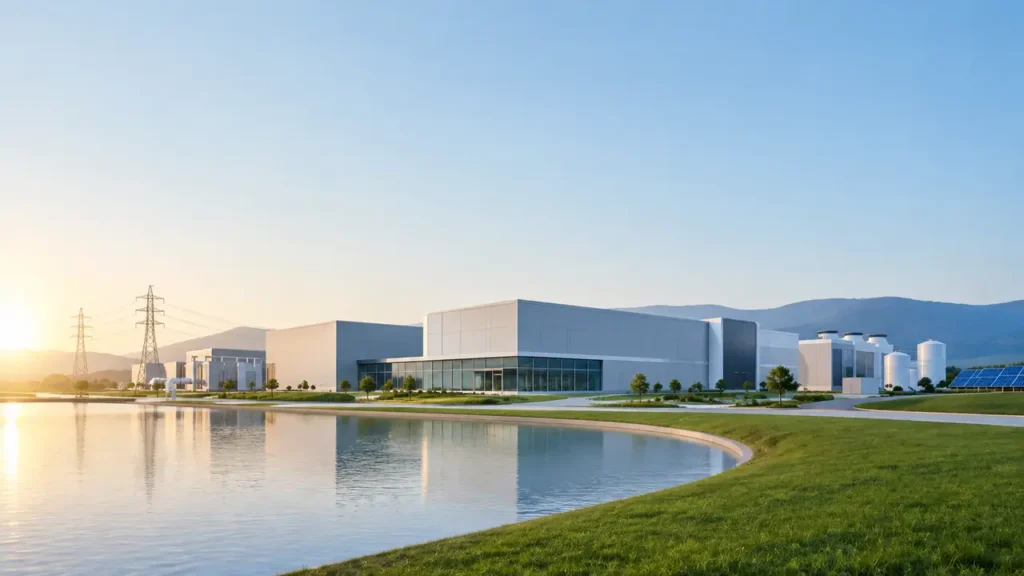
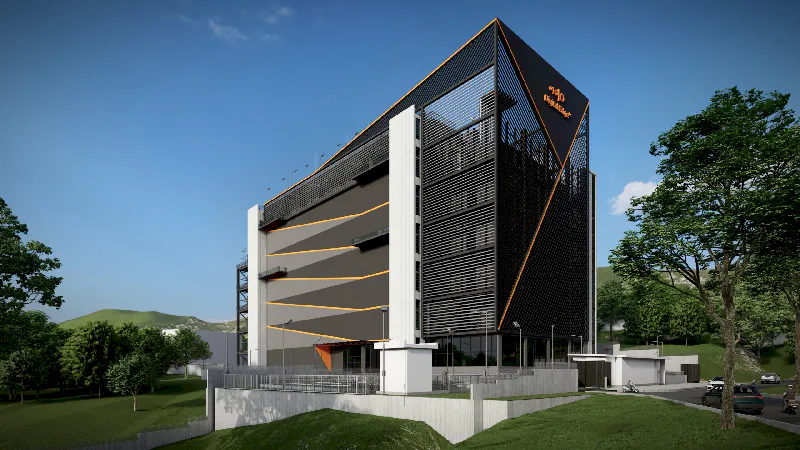
Digital Edge’s BOM campus in Navi Mumbai reflects that pattern: 350MW planned across 47 acres of freehold land, with a flexible design supporting eight to nine build-to-suit buildings. BOM1 data center is the first phase of that campus. A footprint of that size is considerably easier to assemble on the mainland.
What makes Mumbai India’s international gateway?
Mumbai is where most of India’s international capacity comes ashore. The cable landing stations on the city’s western coastline terminate a large share of the submarine systems connecting India to Europe, the Middle East, and Southeast Asia. That makes the metro India’s primary interconnection point, not simply its largest capacity market. You can review current system landings on the Submarine Cable Map — TeleGeography.
That gateway status matters for site selection in a specific way. Say your traffic is largely international, or you are serving users across the Middle East and Southeast Asia from India. In that case the depth of the carrier and cloud ecosystem at your facility will affect performance more than raw distance to the coast. The metro fibre between Navi Mumbai and the city’s landing stations is well established. The question is less about proximity and more about how many distinct paths and providers you can reach on site.
For teams aligning terminology before an evaluation, our explainer on what data center interconnection covers sets out the terms used in cross-connect and on-ramp discussions.
How should buyers read power availability in this market?
Power is a primary constraint across most APAC metros, and Mumbai is no exception. Grid connection timelines, as much as construction schedules, shape when capacity becomes usable. A useful early question is how a site’s land, its power applications, and its contracted and energised power each stand, since those can sit at different stages of maturity.
Renewable procurement in India also works differently from most markets, and the mechanism is worth understanding. Open-access rules let large consumers buy directly from generators. The favourable treatment generally depends on holding captive user status, which usually means taking an equity position in the generating asset rather than simply signing an offtake agreement. When comparing renewable commitments across sites, it helps to know which structure sits behind each one.
Digital Edge signed an 83MW solar PPA with Hexa Climate Solutions for the first phase of the BOM campus following a competitive tender, taking a minority equity stake to secure captive user status. Power is delivered in phases from December 2026. The volume represents the maximum renewable capacity permissible under current regulations for that phase — a useful illustration that regulatory ceilings, not appetite, often set the limit. For the wider pattern, see how renewable PPAs are reshaping site selection, and the International Energy Agency’s India profile for national context.
What does water availability mean for cooling here?
Mumbai is hot and humid for much of the year, and municipal water is under real competing demand from a dense urban population. Rack densities are climbing and liquid cooling is becoming standard for AI workloads. The volume of water a campus needs has stopped being a rounding error in the environmental report. It is now a live question about whether the site can run at full load during a dry year.
The practical questions are straightforward: where the cooling water comes from, whether it competes with municipal supply, and how the design responds if that source is restricted. These tend to be easier to work through at the design stage than after a facility is commissioned.
At the BOM campus, Digital Edge deploys liquid cooling supplied by 10 million litres of recycled water per day, buying greywater the municipality would otherwise discharge to sea. The design targets an annualised PUE of 1.25 and a WUE below 1.75, and the arrangement creates a revenue stream for the local community rather than drawing on drinking water. It is the kind of structural answer worth looking for when comparing sites in water-stressed metros.
Which compliance signals matter for Indian deployments?
India’s data protection regime and its sector-specific rules operate on different tracks, and the distinction is worth establishing early. Sectoral regulators — most visibly in payments and financial services — set their own in-country requirements, which can be more specific than the general privacy framework. For regulated workloads, the operative obligation usually comes from the sector regulator, and confirming the current position with your legal team is the reliable starting point, since it determines which facilities qualify.
Certification is the other half of the picture, because it determines how much of your audit you can inherit rather than perform. The Navi Mumbai campus carries ISO 9001, ISO 14001, ISO/IEC 27001, ISO 45001, and ISO 50001, along with SOC 2 Type II and PCI DSS, with LEED Gold expected. For financial and payments workloads, PCI DSS and SOC 2 Type II are usually the two that shorten diligence most.
Worth separating from all of this: certification is not the same as resilience topology. Our guide to data center tiers covers what Uptime classification does and does not tell you about a facility’s redundancy design.
How much expansion headroom should you underwrite?
Campus-scale sites in India are built in phases, and the phasing repays attention early. Contracting for a first tranche does not in itself secure your ability to grow into the same campus three years later, particularly where intervening phases have already been committed to other customers. Where demand is strong, capacity can be spoken for well ahead of completion, which makes expansion optionality a commercial term worth negotiating rather than assuming.
The useful questions are whether the provider holds the land for later phases outright, whether power for those phases is already secured, and whether your agreement includes any right of first refusal on adjacent capacity. Freehold land and a defined multi-building masterplan make those conversations more concrete — the BOM campus, for instance, plans eight to nine build-to-suit buildings across its 47 acres. Where later phases depend on land or power still being secured, it is worth understanding the expected timeline.
What belongs on a Mumbai shortlist?
Pulling the dimensions together, a workable evaluation covers four things that behave differently in India than elsewhere. On power, distinguish contracted and energised capacity from applications in progress, and understand how renewable supply is structured. On water, establish the cooling source and its exposure to municipal restriction. On land, confirm tenure and whether later phases are available to you. On compliance, start from your own regulator’s requirements and use certifications to confirm how much of the audit you can inherit.
What characterises Mumbai is the pairing of gateway connectivity with campus-scale land inside a single metro, a combination that is comparatively rare among the region’s established hubs. For the national picture behind this metro view, our India market insights piece covers the demand drivers and market structure, and emerging data center markets in Southeast Asia sets the regional comparison.
Conclusion
The Mumbai data center market is really two markets: the island that generates demand and the mainland that hosts it. Once Navi Mumbai is understood as where the capacity sits, the rest of the evaluation becomes more tractable. The questions come down to power structure, water source, land tenure, and expansion rights — in roughly that order of difficulty.
The market is also moving quickly, which puts a premium on understanding what has already been secured at a given site. Contracted power, land tenure, and a settled answer on cooling water all take time to put in place. Together they shape whether a site can still support you at your third phase rather than only your first.
Talk to Digital Edge
Digital Edge’s Navi Mumbai campus offers 350MW of planned capacity on 47 acres of freehold land, with build-to-suit and hyperscale options backed by contracted renewable power and recycled-water cooling. Talk to our team about how the phasing maps to your deployment timeline.