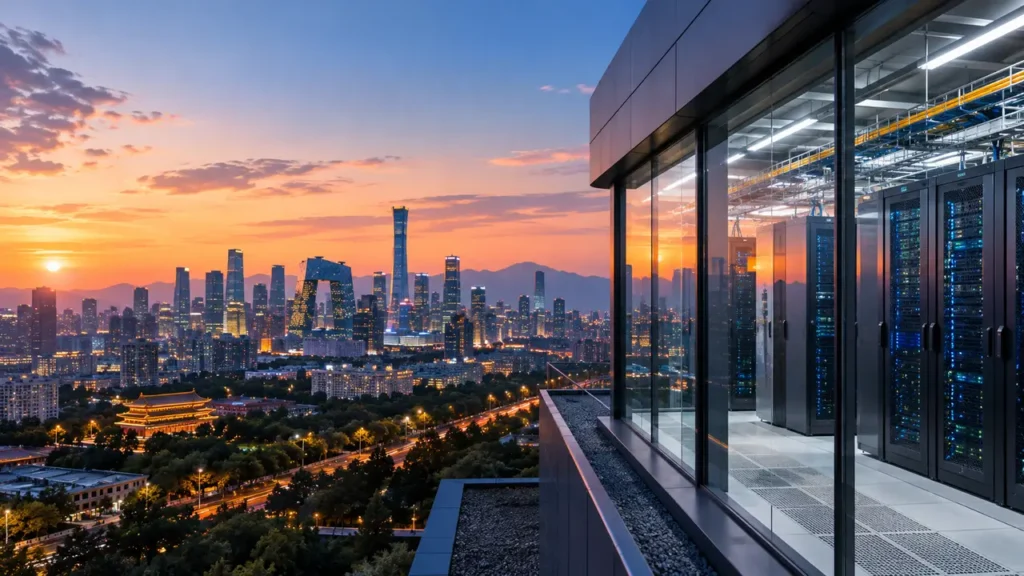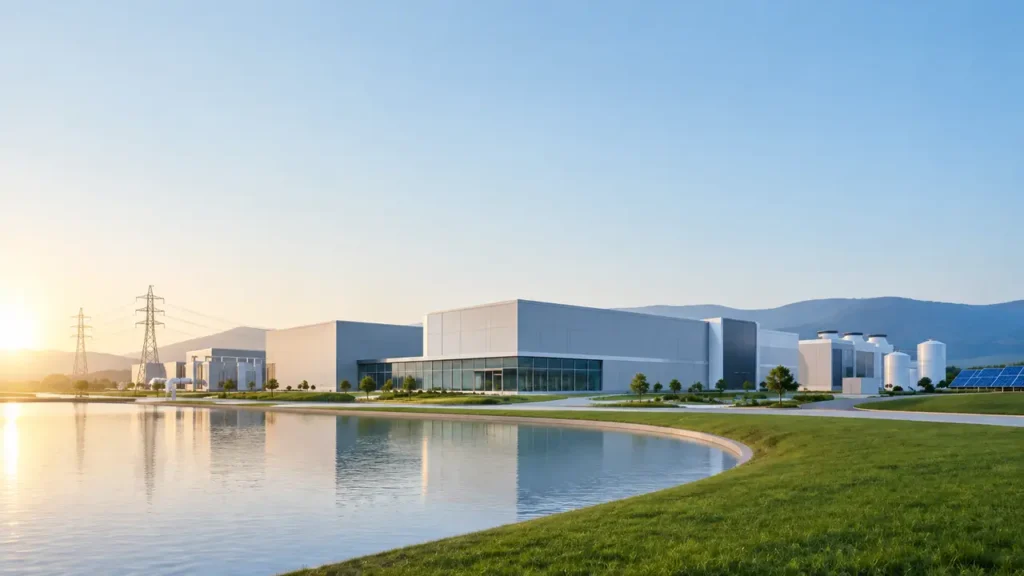
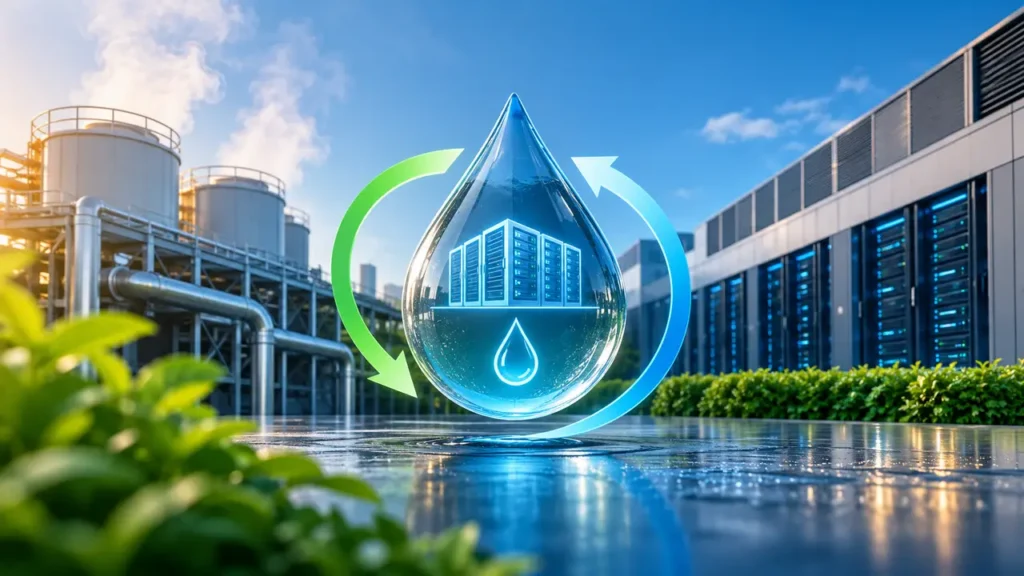
The growth of AI and other high-density workloads is putting greater focus on how data centers manage energy, water and cooling. Water and energy performance increasingly influence data center selection and sustainability reporting. Cooling designs play a central role in moving heat out of the building, and that requires a balance between electricity and water use. That balance shapes a facility’s PUE and WUE figures. This article covers what those metrics measure, how each cooling technology affects them, and how to compare data centers in context.
What is water usage effectiveness?
Water usage effectiveness, or WUE, expresses how much water a facility uses for every unit of energy delivered to IT equipment. It is written in liters per kilowatt-hour, so a WUE of 1.35 means roughly 1.35 liters of water consumed for each kilowatt-hour of IT load. A lower WUE indicates less on-site water consumption per unit of IT energy, although the cooling design and water source remain important context.
The metric covers water consumed on site, which in practice means water lost to evaporation in cooling towers or evaporative systems, plus smaller volumes used for humidity control and water treatment. It is measured over a year rather than at a moment, because evaporation varies enormously with weather. As with PUE, the figure describes a facility’s design and operating choices rather than its absolute environmental impact, so the source of the water matters alongside the volume.
How is WUE different from PUE?
PUE measures energy overhead: total facility energy divided by IT energy. WUE measures water consumption against the same IT energy base. They share a denominator, which is what makes them comparable, and they often move in opposite directions.
Evaporative heat rejection can reduce mechanical refrigeration and improve PUE while increasing water consumption. Mechanical cooling with a closed water loop may use less water but require more energy. The appropriate balance depends on climate, electricity supply and local water availability. PUE and WUE are therefore most useful when reviewed together with the underlying cooling design. PUE remains the more widely published of the two, partly because it applies to every facility while WUE applies only to water-cooled sites. Our article on questions ESG leaders should ask covers the wider set of metrics worth requesting.
How do cooling technologies balance water and energy use?
Heat rejection methods sit on a spectrum from no water to high water consumption. Working from the dry end:
- Air-cooled chillers and direct expansion systems reject heat to the air through refrigerant and fans, consuming essentially no water. Their energy needs may increase, particularly in hot climates, so PUE rises as ambient temperature does.
- Closed-loop and hybrid cooling towers circulate water that is cooled without being evaporated, or evaporate only during hot periods. Water use is modest, balancing predictable water use with energy performance.
- Open cooling towers evaporate water continuously to reject heat. This is energy-efficient and widely used, and it is the main source of water consumption in conventional data center designs.
- Adiabatic and evaporative systems pre-cool incoming air by evaporating water, lowering energy use substantially in dry climates and much less so in humid ones.
Air-side economization, often called free cooling, cuts across this spectrum. Where the outside air is cool enough for enough of the year, it reduces both energy and water use, which is why cooler markets have an inherent advantage. In Digital Edge’s South Korea portfolio, the SEL5 development in Ansan pairs a chiller plant with integrated free cooling, targeting an annualized PUE below 1.25.
How can cooling design respond to local climate?
Cooling performance depends on matching heat-rejection technology to local temperature and humidity. NARRA1 in Manila, the Philippines lists a designed annual PUE of 1.24, a designed peak PUE of 1.35, and a designed WUE of 1.082; EDGE2 in Jakarta, Indonesia lists a designed annual PUE of 1.25 and the same designed WUE. For context, the Uptime Institute’s global survey has placed the industry average PUE at around 1.55. Manila and Jakarta are both close to the hardest case for evaporative cooling, since humid air absorbs less additional moisture, which is what makes these design figures worth noting. Our Philippines data centers and Indonesia data centers pages cover both facilities in more detail.
Does liquid cooling use more or less water?
Liquid cooling does not determine water consumption by itself. Direct-to-chip liquid cooling and immersion cooling move heat away from the processor more efficiently than air does, but they do not determine how that heat leaves the building. A liquid-cooled hall can reject heat through a dry cooler, a closed loop, or an evaporative tower, and the water consumption follows that choice rather than the liquid loop itself.
This distinction is important for high-density and AI-ready environments. What liquid cooling does change is the temperature at which heat is available. Because it captures heat in a warmer, more concentrated form than air cooling, it widens the range of conditions in which heat can be rejected without mechanical refrigeration, which tends to help both figures. The CGK Campus in Indonesia is designed with direct-to-chip liquid cooling and recycled water systems, targeting an annualized PUE of 1.25. In Thailand, the BKK Campus uses hybrid closed-loop cooling towers specifically to reduce water consumption. Both are liquid-capable designs that handle heat rejection differently, which is the point.
Why does a WUE figure need its boundary stated?
Because the same number can describe very different situations, and the qualifiers carry most of the meaning. Three of them matter most.
The first is scope. WUE applies only to facilities that use water-based cooling, so an air-cooled site is not comparable and is normally excluded rather than reported as zero.
The second is whether the figure is a design target or a measured result. Digital Edge’s facility specifications label theirs explicitly as designed PUE and designed WUE, which is the distinction worth looking for: a design figure describes what the engineering is built to achieve under defined conditions, while an operating figure describes what a year of real weather and real load produced.
The third is the water source. A facility consuming recycled or non-potable water places very different pressure on local supply than one drawing the same volume from municipal drinking water. At the Navi Mumbai campus, liquid cooling is supported by 10 million liters per day of recycled greywater, with a target WUE below 1.75.
How should WUE be assessed for AI and high-density workloads?
AI and other high-density workloads increase the importance of understanding both facility efficiency and total resource use. Consistent reporting boundaries help customers compare different facilities and cooling designs.
The main distinction is between on-site and off-site water. WUE, as described above, counts water consumed at the facility. It does not count water used to generate the electricity the facility draws, which can be significant on grids where thermoelectric generation dominates, since those plants consume water for their own cooling. Some analyses report that second figure, often called source water, alongside or instead of site water. Stating the boundary clearly helps ensure meaningful comparisons.
Scale is the other factor. AI workloads raise power density, so a hall running AI equipment draws more energy and, depending on how heat is rejected, can consume more water in absolute terms even where the ratios stay flat or improve. Because efficiency metrics are ratios, they should be reviewed alongside total consumption and IT load. Location also matters: climate, water availability and electricity supply influence the most appropriate cooling strategy for each facility.
Together, these measures help customers understand how a facility manages water and energy under its specific operating conditions.
Conclusion
WUE is most useful when considered alongside PUE, cooling design, climate and water source. The appropriate balance between water and energy use varies by location and operating requirement.
For teams evaluating facilities or gathering figures for their own reporting, they should ask four questions: which heat rejection method the site uses, whether the figures are designed or measured, what the reporting excludes, and where the water comes from. These questions enable more informed and consistent comparisons.
Talk to Digital Edge
Digital Edge publishes efficiency and water metrics across its platform in our ESG reporting, covering facilities from Manila to Incheon — talk to our team about the cooling design and reported figures at any site in our colocation portfolio.