Most data center markets in Asia are shaped by how fast capacity can be built. Beijing is shaped by where capacity is permitted to exist at all. Beijing data center restrictions have limited new construction across the city’s central districts for years, while energy-efficiency requirements for new and expanding facilities have tightened. For teams planning a deployment in the capital, that changes the question from which provider has the best site to which sites are available in the city in the first place.
What restrictions have reshaped Beijing’s data center market?
Two policy directions, applied over several years, have reshaped supply. The first restricted new construction geographically. According to analysis by 451 Research, rules introduced in 2015 placed significant restrictions on new and expanded data center development in six central Beijing districts—Dongcheng, Xicheng, Chaoyang, Haidian, Fengtai, and Shijingshan. Efficiency requirements have also tightened over time. The PUE threshold applied to approved facilities moved from 1.5 to 1.4 in 2018 and later to 1.3, with new and expanding facilities assessed against it. The city also introduced energy-efficiency reviews and higher power tariffs for sites that fall short.
Together, these restrictions shape two local conditions that matter most. Opportunities for new development within the central districts are highly constrained, so expansion within the urban core is not simply a matter of cost or timing. Power is governed less by availability than by the efficiency standards a project must meet before approval. Neither restriction removes existing capacity, which is an important distinction when planning a site search.
Where has new capacity gone instead?
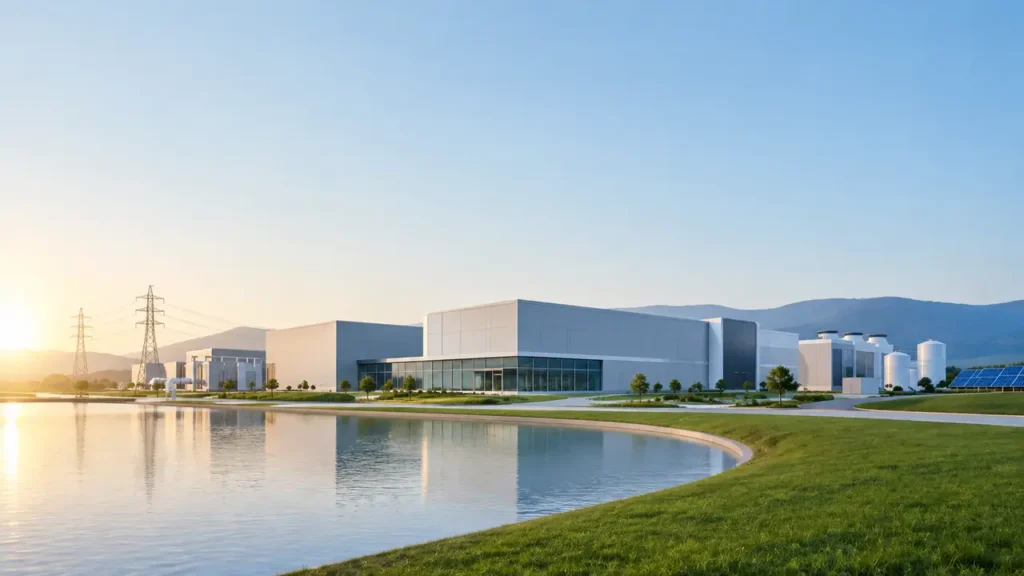
Largely to the provinces around the capital, and further west. Hebei, Tianjin, and Inner Mongolia have absorbed much of the new supply serving Beijing demand, with cooler climates and lower power costs making it easier to meet efficiency requirements. The national “East Data West Computing” initiative, launched in 2022, formalized the broader pattern by encouraging data processing to move toward western provinces with abundant renewable generation, while keeping latency-sensitive services in the east. Carbon Brief’s explainer sets out how these policies fit together.
Water availability is another factor to consider when assessing cooling design in northern China, particularly for facilities supporting higher-density workloads. Buyers should examine both energy and water performance rather than assessing PUE in isolation. For a workload with no particular latency requirement, an out-of-city site can therefore be the more efficient and straightforward option. The trade-off is distance from users, networks, and staff.
Which workloads still need to sit inside Beijing?
Fewer than teams often assume, but not none. The workloads that genuinely benefit from an in-city position tend to share a few characteristics: they serve users or counterparties concentrated in Beijing, depend on network proximity to carriers and exchange points in the city, or support business functions where staff need physical access at short notice.
Trading and payments systems, interactive platforms with a large Beijing user base, and front-end infrastructure for government-facing or enterprise-facing services commonly fall into this group. Batch processing, archival storage, model training, and most back-office systems usually do not. Many enterprises end up splitting the two, keeping a smaller in-city footprint for latency-sensitive and network-dependent components while placing bulk capacity in a neighboring province. That split works well when the network design between the two sites is planned deliberately rather than added afterward.
The growth of AI inference is also increasing demand for infrastructure closer to users and network traffic. Sometimes described as “AI factories” or “token factories”, these environments generate AI outputs continuously and can be sensitive to latency. For customers serving users in Beijing, PEK1’s access to the city’s network infrastructure may make it relevant for latency-sensitive inference deployments.
Why does existing in-city capacity matter under Beijing’s restrictions?
Because comparable in-city capacity is difficult to replicate under current planning and efficiency constraints. In most markets, a provider’s position in a metro reflects investment decisions that a competitor could match given time and capital. In central Beijing, facilities inside the restricted districts generally predate the restrictions, which makes existing in-city capacity a structurally different proposition from capacity that is merely planned.
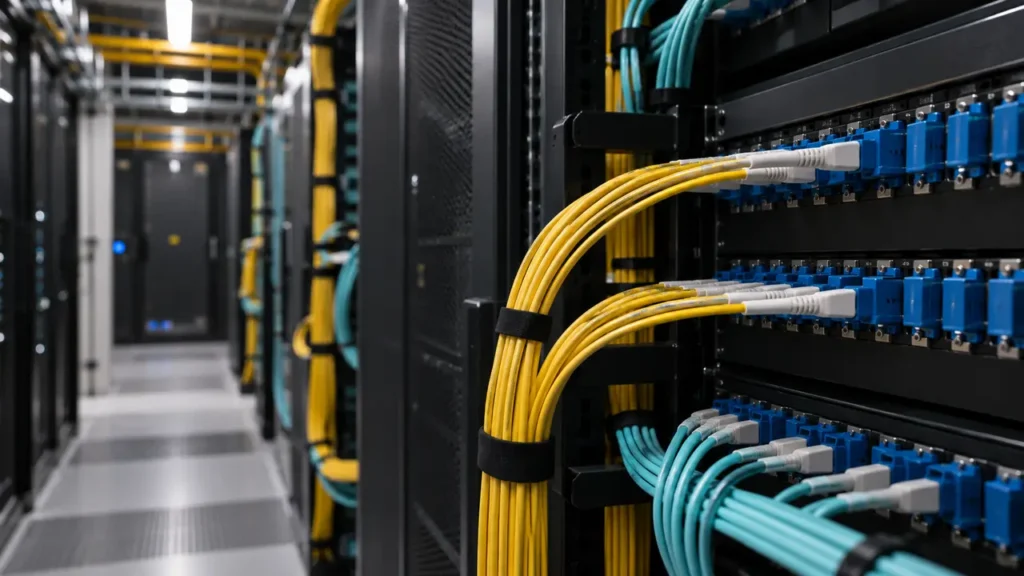
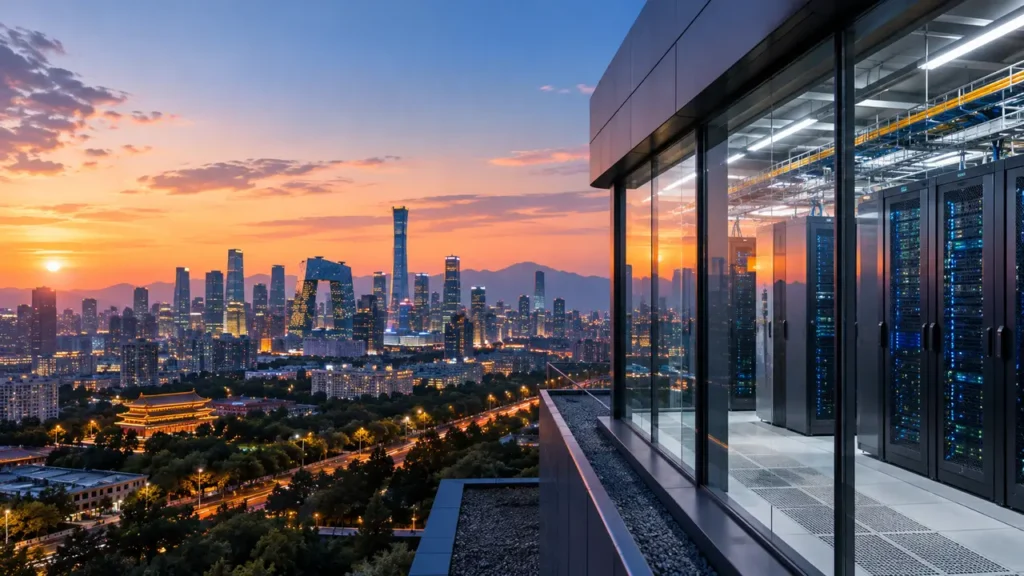
Digital Edge’s PEK1 sits in Chaoyang District, one of the six districts named in the 2015 rules, in a prime position on Beijing’s network infrastructure and within the city’s business district. The facility offers 8,361m² of colocation space across 1,801 cabinets, with 7.8MW of capacity, 4.4kVA per cabinet, 2N UPS redundancy, and a 100% dual power SLA. For buyers, the practical implication is that in-city options in Beijing should be evaluated on what is available now and how much room each site has to grow, rather than on a provider’s development pipeline. Our China data centers page sets out the facility in more detail.
How do enterprises actually contract capacity in China?
Providing commercial data center and internet data center services in mainland China requires the relevant local licences. International customers therefore need to understand which licensed entity operates the facility and contracts for the services they use.
This is where our article on China disaster recovery becomes relevant. It makes the case for separating operators across primary and secondary sites, because an operator is a shared dependency: two facilities run by the same entity share regulatory and operational exposure as well as infrastructure. In China, acting on that means choosing among licensed local operators rather than among international providers, and understanding who actually runs each site on a shortlist. Anyone planning a second site will find the full argument there.
Digital Edge’s PEK1 operates through Chuanjun Information Technology, a fully licensed China operator, with bilingual support and local regulatory expertise alongside Digital Edge’s platform standards. For a wider view of when local hosting is necessary at all, and how cloud and colocation compare in this market, our China colocation guide covers the earlier stages of that decision.
Which compliance signals are worth checking?
The ones that show a facility has been assessed against both local and international standards. In China, the two sit side by side, and a site that holds only one set tells an incomplete story.
On the local side, CQC certification against GB50174-2018 Level A covers data center design and construction under the Chinese national standard, and Cybersecurity Protection Level 3 reflects assessment under the country’s cybersecurity classification regime. On the international side, PEK1 holds ISO/IEC 27001 for information security management, together with ISO 9001, ISO 14001, ISO 14064, ISO 45001, and ISO 50001. Buyers should confirm that each certification remains current and understand whether it applies to the facility, the local operator or the wider Digital Edge platform.
For teams whose own reporting or audit obligations extend across markets, the useful question is whether a provider’s certification set is consistent across its footprint or assembled facility by facility. Consistency makes it easier to reuse evidence across markets rather than rebuilding it for each one.
How does a Beijing deployment connect to the rest of Asia?
Beijing’s value to many architectures is as much about network position as floor space. The city is a dense carrier environment, and an in-city facility gives access to that ecosystem in a way an out-of-province site does not. Interconnection services within the facility handle connections between endpoints on site, which matters when a deployment spans several parties.
It is also worth being clear about which workloads need to be in mainland China at all. Regional services, aggregation layers, and capacity serving users across Asia often sit more naturally in Japan or South Korea, where Digital Edge operates facilities directly and where cross-border connectivity is more straightforward. A common pattern is a focused Beijing footprint for what must be in-country, with regional capacity elsewhere in Asia, connected deliberately rather than by default.
Conclusion
Beijing data center restrictions have made site selection a question of both location and availability. The questions that matter are which facilities exist inside the restricted districts, how much capacity each has available, who holds the operating licence, and which parts of the workload genuinely need to be in the city rather than in a neighboring province.
For most enterprises, the answer is a smaller in-city footprint than first assumed, paired with capacity elsewhere and a network design that connects the two properly. Understanding the restrictions early helps teams plan around Beijing’s constraints, evaluate existing capacity realistically, and determine which workloads genuinely need an in-city deployment.
Talk to Digital Edge
Digital Edge’s colocation services include PEK1 in Chaoyang District alongside facilities across Asia-Pacific — talk to our team about what a Beijing deployment would need and how it fits with capacity in the wider region.