The term AI-ready data center is everywhere — especially as AI workloads move from pilot environments into production. Many discussions focus almost entirely on rack density, but that single metric rarely captures what an AI environment needs to run reliably at scale, day after day.
While power density matters, teams evaluating AI-ready data center options in Asia often need to consider a wider set of factors — particularly cooling strategy, interconnection design, expansion flexibility, and how well the local market supports long-term AI growth.
Power density matters, but it is not the whole answer
AI environments can change power requirements substantially, but a density figure is most useful when it comes with context. Helpful follow-up questions from a high-density claim include: what are the operating assumptions behind the headline number, how the environment behaves under sustained load, and whether the design can support scale and expansion plans beyond the first deployment.
In practice, AI readiness tends to look like “high density plus a clear operating model” — defined power delivery and redundancy, transparent limits, and a realistic path to add capacity without redesigning the environment within the first growth phase.
Cooling strategy changes whether the site is actually AI-ready
That includes whether the cooling strategy is air, hybrid, or liquid-assisted, how density support changes by deployment profile, and what options exist as requirements evolve.
Cooling design also connects AI and sustainability in practical ways — particularly for teams managing continuous GPU utilization rather than bursty enterprise loads. The choices a facility makes can affect efficiency, serviceability, and long-term operating confidence, not just technical readiness.
Interconnection still matters for AI
AI conversations can sometimes become too facility-centric and leave the network as an afterthought. In real-life deployments, connectivity to data sources, cloud environments, distributed teams, or adjacent inference and application platforms are part of the design from the start. For many AI platforms, data movement becomes the bottleneck long before compute does.
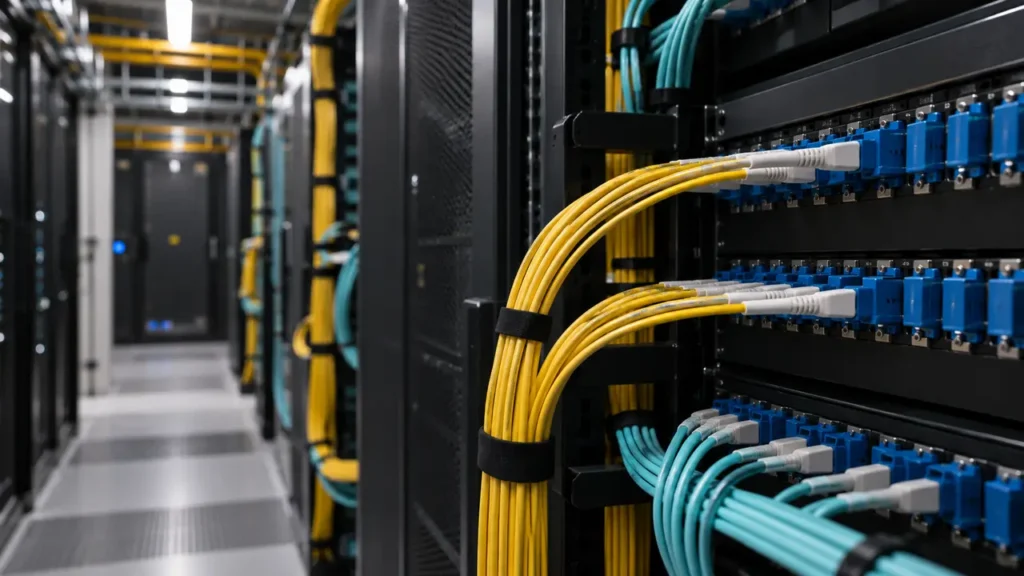
That is why Interconnection services remain relevant even in AI environments. If the training or inference environment cannot move data cleanly, integrate with the rest of the platform/AI stack, or expand without creating a network bottleneck, the deployment may still underperform even inside a technically capable facility.
A production AI platform rarely lives alone. It usually has to exchange data with applications, storage, observability tooling, security controls, and sometimes public cloud services. That means network quality is part of AI readiness, not a side topic that gets solved later.
Market selection still shapes the AI outcome
Not every AI deployment — training, inference, or mixed workloads — needs the same metro or even the same kind of market. Some environments prioritize scale, land, and future campus planning. Others depend more on ecosystem access, enterprise adjacency, cloud reachability, or regional positioning. Market selection can influence outcomes just as much as facility design.
If you are comparing locations, it can help to review market pages such as Jakarta data centers, Tokyo data centers, or Thailand data centers. Digital Edge’s Indonesia footprint is positioned around ultra-low latency downtown facilities for financial and digital platforms, carrier-neutral by design, with future hyperscale-AI expansion already in view. AI infrastructure does not sit outside geography. It still lives inside a geography, and the market can shape both performance and long-term options.
Growth planning matters more for AI than for many standard deployments
AI projects rarely stay static. Even when the first deployment is well scoped, the environment may evolve as inference grows, model operations change, or adjacent workloads move closer to the platform. For that reason, growth and expansion planning is often a core part of early site evaluation.
Useful questions here include whether the site supports phased expansion, whether the market can support a larger future footprint, and how the provider thinks about denser growth over time. This is one reason AI content should connect to Hyperscale infrastructure, not exist as detached trend content without a real deployment path behind it.
A practical checklist for AI readiness
When comparing sites, many teams find it helpful to review AI readiness across five dimensions:
- Sustained AI density support
- Cooling strategy aligned to GPU workloads
- Interconnection and data movement fit
- Market suitability for AI growth
- Room for phased expansion over multiple build stages
A gap in any one area does not automatically rule a site out – different AI workloads have different priorities. The goal is usually to understand the trade-offs clearly and decide what matters most for the current phase of the deployment.
Over time, many experienced teams focus less on marketing labels and more on how the environment will behave as the platform matures. Clarity on operating limits, expansion paths, and ecosystem fit can reduce surprises later – especially for workloads that grow faster than the initial build plan.
Conclusion
In many cases, the strongest AI-ready data center is not just the one that publishes the highest density number, but the one that continues to perform predictably as AI workloads scale and change. It is the one that supports the workload operationally, grows with the deployment, and sits in the right market with the right cooling and interconnection model behind it.
Digital Edge supports AI infrastructure across Asia with a focus on density, cooling, interconnection, and scalable market positioning. If useful, please contact our team so we can walk you through how these factors apply to your specific AI workload and deployment phase.